

This traditional French holiday dish, known as L’Estouffat de Noel, transforms tough cuts of beef into melt-in-your-mouth tenderness through a long, slow marination and gentle simmering process. The deep, complex flavors come from a robust mixture of Bordeaux red wine, cognac, and red wine vinegar, infused with aromatic herbs like thyme and parsley. The addition of bacon, leeks, and carrots provides a savory depth and hearty texture that warms the soul. This stew is ideal for Christmas dinner or any special occasion where you want to impress guests with authentic, rustic elegance. Serve it over creamy mashed potatoes for a complete, satisfying meal that captures the essence of a classic French kitchen.
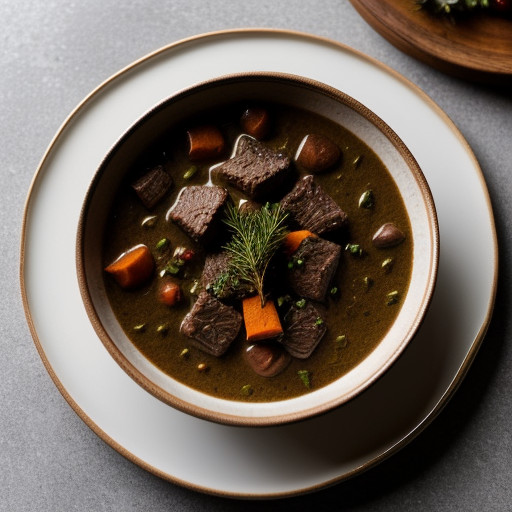
L’Estouffat De Noel (Bordeaux Christmas Beef Stew)
Description
This traditional French holiday dish, known as L'Estouffat de Noel, transforms tough cuts of beef into melt-in-your-mouth tenderness through a long, slow marination and gentle simmering process. The deep, complex flavors come from a robust mixture of Bordeaux red wine, cognac, and red wine vinegar, infused with aromatic herbs like thyme and parsley. The addition of bacon, leeks, and carrots provides a savory depth and hearty texture that warms the soul. This stew is ideal for Christmas dinner or any special occasion where you want to impress guests with authentic, rustic elegance. Serve it over creamy mashed potatoes for a complete, satisfying meal that captures the essence of a classic French kitchen.Directions
-
Cut the beef into large 8-ounce chunks to prevent them from falling apart during the long cooking process.
-
Cut the carrots into 1-inch chunks.
-
Use only the white parts of the leeks, halve them lengthwise, wash thoroughly to remove grit, and cut into 1-inch chunks.
-
Thinly slice the onions.
-
Chop the shallots and peel and mash the garlic cloves.
-
Thinly slice the celery rib.
-
Cut the bacon rashers into 1-inch slices.
-
Combine the beef, vegetables, bacon, bay leaf, parsley, peppercorns, thyme, salt, cloves, Bordeaux wine, red wine vinegar, and cognac in a heavy 8 to 10-quart casserole dish.
-
Cover and marinate in the refrigerator for 24 hours, turning the meat occasionally.
-
Remove the casserole from the refrigerator and slowly bring the contents to a simmer on the stovetop.
-
Prepare a luting paste by mixing flour and water to a dough-like consistency.
-
Place the lid on the casserole and apply a thick strip of the luting paste around the rim where the lid meets the pot to create an airtight seal.
-
Place the sealed casserole in an oven preheated to 100°F to 150°F and simmer gently for 8 to 10 hours.
-
Remove from the oven, break the crust seal, and serve the tender beef and vegetables over mashed potatoes.
Nutrition Facts
Servings 4 servings
- Amount Per Serving
- Calories 2569.9kcal
- % Daily Value *
- Total Fat 172.8g266%
- Saturated Fat 54.6g273%
- Cholesterol 410.4mg137%
- Sodium 2450mg103%
- Total Carbohydrate 53.6g18%
- Dietary Fiber 13.7g55%
- Sugars 13.6g
- Protein 187.9g376%
* Percent Daily Values are based on a 2,000 calorie diet. Your daily value may be higher or lower depending on your calorie needs.
