

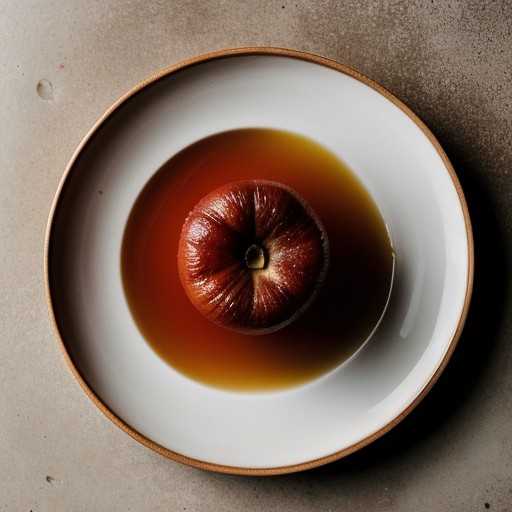
This traditional Greek quince jelly, known as Kythoni Peltes, transforms tart quinces into a luxurious, floral preserve. The slow-cooking process extracts the natural pectin and vibrant color, while rose geranium leaves add a sophisticated, perfumed aroma that elevates the fruit’s natural sweetness. The result is a firm, translucent jelly with complex flavor notes of honey and spice. It is an excellent accompaniment to sharp cheeses, roasted meats, or as a glaze for pork. This recipe requires patience but yields a beautiful, artisanal product that is perfect for holiday gifting or enjoying during cozy winter mornings.
Kythoni-Peltes-Quince-Jelly_1
Description
This traditional Greek quince jelly, known as Kythoni Peltes, transforms tart quinces into a luxurious, floral preserve. The slow-cooking process extracts the natural pectin and vibrant color, while rose geranium leaves add a sophisticated, perfumed aroma that elevates the fruit's natural sweetness. The result is a firm, translucent jelly with complex flavor notes of honey and spice. It is an excellent accompaniment to sharp cheeses, roasted meats, or as a glaze for pork. This recipe requires patience but yields a beautiful, artisanal product that is perfect for holiday gifting or enjoying during cozy winter mornings.Ingredients
Directions
-
Wash quinces well to remove the fuzz.
-
Peel and core the quinces.
-
Slice quinces into a preserving pan and add 2 cups of water.
-
Place the peels and cores into a separate pan with the remaining 2 cups of water and boil for 30 minutes.
-
Strain the liquid from the peels and cores, discarding the solids.
-
Add the strained liquid from the peels to the sliced quinces in the first pan.
-
Bring to a boil and simmer gently for 1 hour until the quince flesh is very tender.
-
Scald a large piece of cheesecloth or doubled butter muslin, wring it out, and drape it over a deep bowl.
-
Pour the quince and liquid mixture into the clean cloth and gather up the ends.
-
Tie the bundle with string and suspend it over the bowl, securing it to a fixed object so the juice can drip slowly.
-
Leave to drip for 24 hours. Do not squeeze the bag, as this will make the jelly cloudy.
-
Measure the collected juice and pour it into a clean preserving pan.
-
For each cup of juice, add 1 cup of sugar.
-
Stir over heat until the sugar dissolves completely.
-
Add the lemon juice and washed rose geranium leaves, then bring to a boil.
-
Boil rapidly for 25 minutes, skimming the foam frequently.
-
Test the jelly by placing a teaspoonful on a cold saucer and allowing it to cool slightly.
-
Run your finger across the jelly on the saucer; if the surface wrinkles, the setting point is reached.
-
Remove the pan from the heat while testing to avoid overcooking.
-
Remove the geranium leaves and ladle the hot jelly into hot sterilized jars.
-
Seal the jars once they have cooled.
Nutrition Facts
Servings 1
- Amount Per Serving
- Calories 0.0kcal
- % Daily Value *
- Total Fat 0.0g0%
- Saturated Fat 0.0g0%
- Cholesterol 0.0mg0%
- Sodium 0.0mg0%
- Total Carbohydrate 0.0g0%
- Dietary Fiber 0.0g0%
- Sugars 0.0g
- Protein 0.0g0%
* Percent Daily Values are based on a 2,000 calorie diet. Your daily value may be higher or lower depending on your calorie needs.
