

Kythoni Peltes is a classic Greek preserve that transforms the firm, astringent quince into a luminous, amber-hued jelly. This recipe highlights the fruit’s intense floral aroma and tart sweetness, enhanced by the subtle, perfumed undertones of fresh rose geranium leaves. The resulting spread has a beautiful translucent appearance and a firm, glossy set, making it an elegant accompaniment to cheese boards, roasted meats, or breakfast pastries. While the process requires patience, particularly during the straining phase, the effort yields a sophisticated condiment that captures the essence of the Mediterranean harvest. It is a timeless treat perfect for gifting or savoring slowly over the colder months.
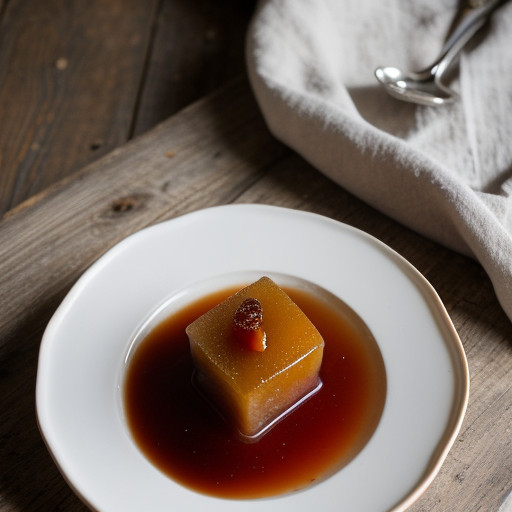
Kythoni Peltes (Quince Jelly)
Description
Kythoni Peltes is a classic Greek preserve that transforms the firm, astringent quince into a luminous, amber-hued jelly. This recipe highlights the fruit's intense floral aroma and tart sweetness, enhanced by the subtle, perfumed undertones of fresh rose geranium leaves. The resulting spread has a beautiful translucent appearance and a firm, glossy set, making it an elegant accompaniment to cheese boards, roasted meats, or breakfast pastries. While the process requires patience, particularly during the straining phase, the effort yields a sophisticated condiment that captures the essence of the Mediterranean harvest. It is a timeless treat perfect for gifting or savoring slowly over the colder months.Ingredients
Directions
-
Wash the quinces thoroughly to remove any fuzz, then peel and core them.
-
Slice the quince flesh into a preserving pan and add 2 cups of water.
-
Place the reserved peels and cores in a separate pan with the remaining 2 cups of water and boil for 30 minutes.
-
Strain the liquid from the peels and cores, discarding the solids.
-
Add the strained liquid from the peels to the sliced quince flesh in the main pan.
-
Bring to a boil, then reduce heat and simmer gently for 1 hour until the quince flesh is very tender.
-
Scald a large piece of cheesecloth or doubled butter muslin, wring it out, and drape it over a deep bowl.
-
Pour the cooked quince and liquid into the cloth bag, gather the ends, tie with string, and suspend over the bowl to drain slowly for 24 hours.
-
Measure the drained juice into a clean preserving pan.
-
For each cup of juice, add 1 cup of granulated sugar.
-
Stir over medium heat until the sugar dissolves completely.
-
Add the lemon juice and washed rose geranium leaves, then bring the mixture to a rolling boil.
-
Boil rapidly for 25 minutes, skimming off any foam frequently.
-
Test for setting point by placing a teaspoonful on a cold saucer; if the surface wrinkles when pushed, the jelly is ready.
-
Remove the pan from heat, discard the rose geranium leaves, and ladle the hot jelly into hot sterilized jars.
-
Seal the jars and allow them to cool completely.
Nutrition Facts
Servings 4
- Amount Per Serving
- Calories 25.0kcal
- % Daily Value *
- Total Fat 0.0g0%
- Saturated Fat 0.0g0%
- Cholesterol 0.0mg0%
- Sodium 0.0mg0%
- Total Carbohydrate 6.5g3%
- Dietary Fiber 0.1g1%
- Sugars 6.0g
- Protein 0.0g0%
* Percent Daily Values are based on a 2,000 calorie diet. Your daily value may be higher or lower depending on your calorie needs.
Note
Do not squeeze the draining bag to hasten the process, as this will release pectin and impurities, resulting in a cloudy jelly.
Ensure jars are sterilized and hot before filling to prevent spoilage and ensure a proper seal.
If you cannot find fresh rose geranium leaves, you may omit them, though the flavor profile will be less complex. Alternatively, a small amount of rose water can be added at the end of cooking.
Store sealed jars in a cool, dark place for up to 12 months. Once opened, refrigerate and consume within 3-4 weeks.
