

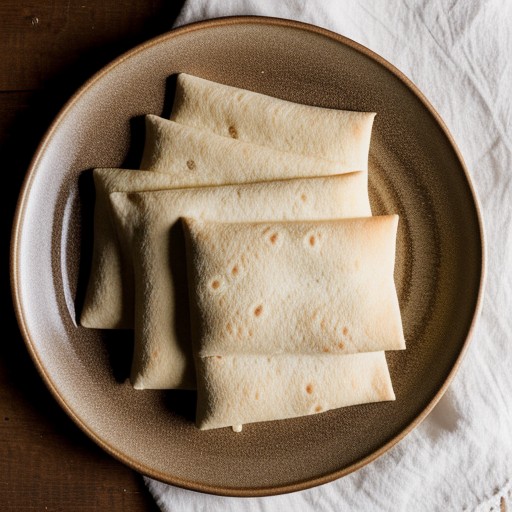
Lefse
Description
Lefse is a traditional Norwegian flatbread that holds a special place in Scandinavian holiday tables. Made from a simple dough of scalded milk, lard, salt, and flour, it yields a soft, pliable bread that is perfect for rolling up with butter and sugar. The key to great lefse is the scalding of the milk, which gelatinizes the starches for a tender crumb, and the use of lard for richness and elasticity. Whether served warm from the griddle or stored for later, this hearty bread brings a comforting, homemade quality to any meal. It pairs beautifully with savory fillings like cheese and salmon or sweet spreads like jam and cloudberry preserves. A festive treat that is surprisingly easy to make with pantry staples.Ingredients
Directions
-
In a saucepan, combine scalded milk, lard, salt, and 2 cups of flour.
-
Cook over low heat, stirring constantly, until the mixture thickens into a smooth dough.
-
Remove the pan from the heat and let the dough cool slightly until manageable.
-
Turn the warm dough out onto a lightly floured surface.
-
Gradually knead in the remaining 2 cups of flour until the dough is smooth, elastic, and no longer sticky.
-
Divide the dough into small patties, roughly the size of a hamburger patty.
-
On a lightly floured surface, roll each patty out into a thin, large circle, aiming for a size that fits your griddle or lefse baker.
-
Heat a griddle or lefse baker to medium-high heat.
-
Carefully transfer the rolled dough to the hot surface using a spatula or pointed stick.
-
Cook for about 1-2 minutes, or until lightly browned and spots appear.
-
Prick any air bubbles with a fork or skewer, then flip and cook the other side until lightly browned.
-
Adjust heat as necessary to prevent burning while ensuring even cooking.
-
Stack cooked lefse and cover with a clean kitchen towel to keep soft.
Nutrition Facts
Servings 6
- Amount Per Serving
- Calories 1194.6kcal
- % Daily Value *
- Total Fat 33.6g52%
- Saturated Fat 13.0g65%
- Cholesterol 2.4mg1%
- Sodium 14677.8mg612%
- Total Carbohydrate 188.4g63%
- Dietary Fiber 6.5g26%
- Sugars 6.7g
- Protein 28.1g57%
* Percent Daily Values are based on a 2,000 calorie diet. Your daily value may be higher or lower depending on your calorie needs.
Note
Storage: Lefse dough can be kept in a cool place for a couple of days before rolling. Cooked lefse can be stacked and stored in a plastic bag or airtight container at room temperature for a few days, or frozen for longer storage.
Equipment: Traditional lefse makers use a specific "lefse baker" (a flat cast-iron griddle) and a Scandinavian rolling pin (which is tapered at the ends). If you do not have these, a regular heavy-bottomed griddle or large skillet and a standard rolling pin work well.
Serving Suggestions: Lefse is traditionally served warm with butter and sugar, rolled up like a crepe. It can also be filled with savory ingredients such as cheese, salmon, or ham.
Variation: This recipe yields a soft bread similar to a Swedish tortilla. Adjust the rolling thickness to your preference; thinner lefse cooks faster and is more delicate.
