

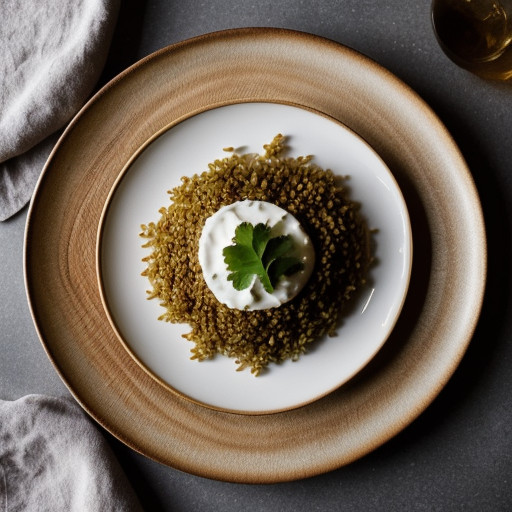
Morassa Polo (Bejeweled Pilaf)
Description
Morassa Polo, or Bejeweled Rice, is a celebratory Persian dish that turns humble basmati into a colorful centerpiece. This recipe features fluffy rice layered with sweet and sour elements: tender carrots glazed with saffron, tart dried barberries, plump currants, and crunchy toasted nuts. The aroma of rose water and warm spices like cardamom and cinnamon infuses the dish with elegance. It offers a delightful contrast of textures and flavors, balancing the earthiness of the rice with the brightness of orange peel and the richness of butter. Perfect for holiday gatherings, special dinners, or whenever you want to impress guests with a visually stunning and deeply flavorful main course.Directions
-
Rinse the basmati rice thoroughly in 5 or more changes of water until the water runs clear.
-
Cover the rinsed rice with water by at least 1 inch.
-
Add 1 tablespoon of salt to the water and soak the rice for 3 hours.
-
While the rice soaks, peel 3 oranges and julienne the peel.
-
In a skillet, fry julienned carrot strips in 2 tablespoons of oil over medium heat, stirring constantly, for 10 minutes.
-
Stir in 1 teaspoon of granulated sugar, 2 teaspoons of liquid saffron, and 2-3 tablespoons of water.
-
Cook until the liquid is reduced, about 4-5 minutes, then remove carrot strips to a bowl and set aside.
-
In a dry skillet, toast 1 teaspoon of almonds over medium heat, then set aside for garnish.
-
Place remaining almonds and all pistachios in a small saucepan, cover with cold water, bring to a boil, and drain.
-
Combine 1 teaspoon blanched almonds, 1 teaspoon blanched pistachios, and the reserved toasted almonds for garnish.
-
Put remaining granulated sugar in a small saucepan with 6 tablespoons of water.
-
Bring slowly to a boil and simmer gently for 10 minutes to create a syrup.
-
Add the orange peel and remaining blanched nuts to the syrup and boil for 30 seconds.
-
Drain the nuts and peel, reserving the syrup.
-
Add the drained peel and nuts to the fried carrot strip mixture.
-
Soak currants in warm water for 10 minutes until puffed and shining, then drain.
-
Separate 1 teaspoon of currants for garnish and add the remainder to the carrot strip mixture.
-
Pick over barberries, then gently fry them in a skillet in a small amount of oil until they glow red, about 1-2 minutes.
-
Separate 1 teaspoon of barberries for garnish and add the remainder to the carrot strip mixture.
-
Stir cinnamon, cardamom, and rose water into the carrot strip mixture and divide the mixture into 3 parts.
-
In a 3-quart saucepan, add 2 quarts of water and 3 tablespoons of salt and bring to a rapid boil.
-
Drain the soaked rice.
-
Add the rice to the boiling water and boil until grains are soft on the outside but still firm in the center, about 2-3 minutes.
-
Drain the rice in a colander and rinse with lukewarm water.
-
Toss the rice gently in the colander to separate the grains.
-
Rinse the saucepan, return it to heat, add some oil, and heat until sizzling.
-
Sprinkle 1/4 of the rice over the bottom of the saucepan.
-
Spread 1/2 of the carrot mixture on top of the rice layer.
-
Sprinkle 1/4 of the rice over the carrot mixture.
-
Repeat with the remaining carrot mixture and rice, ending with a thick layer of rice formed into a conical mound.
-
Pour the reserved syrup and 4 teaspoons of liquid saffron over the rice.
Nutrition Facts
Servings 1 serving
- Amount Per Serving
- Calories 399.3kcal
- % Daily Value *
- Total Fat 1.6g3%
- Saturated Fat 0.3g2%
- Cholesterol 0.0mg0%
- Sodium 3.3mg1%
- Total Carbohydrate 85.8g29%
- Dietary Fiber 1.6g7%
- Sugars 0.0g
- Protein 8.6g18%
* Percent Daily Values are based on a 2,000 calorie diet. Your daily value may be higher or lower depending on your calorie needs.
