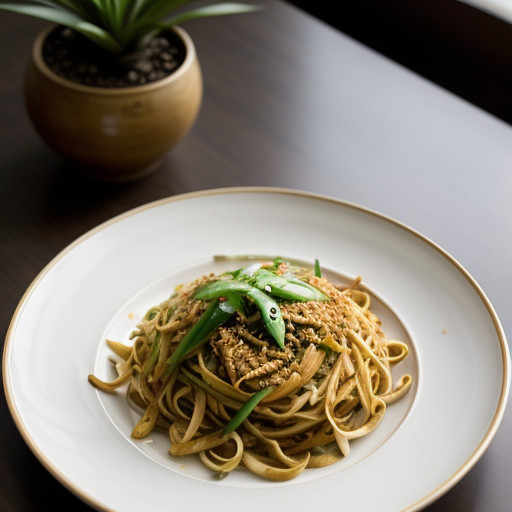
Mix in tamarind sauce, fish sauce, sugar, red chili paste, black pepper, and dried shrimp powder. Stir-fry for another 2 minutes until the noodles are hot and coated in sauce.
8 Remove from heat and toss with bean sprouts, chopped scallions, and half of the chopped peanuts.
9 Plate the Pad Thai. Garnish with remaining peanuts, fresh coriander leaves, lime wedges, and serve immediately.
Servings 1
- Amount Per Serving
- % Daily Value *
- Total Fat 3.6g6%
- Saturated Fat 0.6g3%
- Cholesterol 11.9mg4%
- Sodium 320.1mg14%
- Total Carbohydrate 9.3g4%
- Dietary Fiber 0.6g3%
- Sugars 0.3g
- Protein 3.1g7%
* Percent Daily Values are based on a 2,000 calorie diet. Your daily value may be higher or lower depending on your calorie needs.
Note
The original recipe lists this as vegan but includes chicken, shrimp, fish sauce, and eggs. To make this vegan, omit the animal proteins and use soy sauce or tamari instead of fish sauce, and ensure the tamarind sauce is pure tamarind.
For best results, ensure your wok is very hot before adding ingredients to achieve the characteristic "wok hei" or smoky flavor.
If you cannot find tamarind sauce, you can substitute with a mixture of lime juice and brown sugar, though the flavor profile will be slightly different.
Serve immediately while hot. Leftovers can be stored in an airtight container in the refrigerator for up to 2 days, but the noodles may become gummy when reheated.
Adjust the amount of red chili paste to control the spiciness level according to your preference.
Keywords:
pad thai, thai noodles, stir fry, tamarind, rice noodles, bean sprouts, peanuts, lime, fish sauce, asian cuisine, quick dinner, spicy, sweet and sour, wok, street food, garlic, scallions, chili paste, easy recipe, vegetarian option