

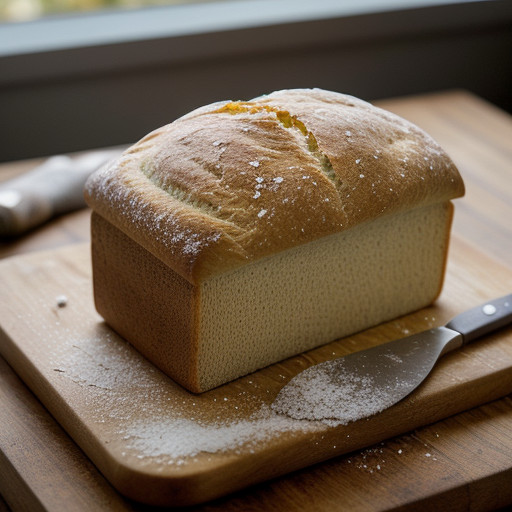
Salt-Rising Bread
Description
Salt-rising bread is a unique, unleavened loaf that relies on a bacterial starter rather than yeast for its rise. This recipe creates a distinctive starter using boiled potatoes, cornmeal, and honey, which ferments to produce a tangy, slightly sour flavor profile. The result is a tender, airy bread that is perfect for sandwiches, stuffing, or simply served warm with butter. While it requires patience for the starter to activate, the effort yields a deeply satisfying, homemade loaf that stands out from standard white breads.Directions
-
Preheat oven to 350°F (175°C).
-
Place thinly sliced potatoes, 3 teaspoons salt, honey, and cornmeal in a stainless steel bowl.
-
Cover the mixture with boiling water.
-
Cover the bowl with a cloth and let stand in a warm place (around 90°F) for about 15 hours to create the starter.
-
Drain the mixture, discarding the potatoes, and reserve the liquid.
-
In a mixer bowl, combine baking soda, remaining 2 teaspoons salt, and 3 cups of flour.
-
Add the reserved potato water and mix on slow speed for about 5 minutes to form a "sponge."
-
Scrape the sponge into a mixing bowl, cover with a damp cloth, and let rise in a warm spot until bubbles form, about 1 1/2 hours.
-
Meanwhile, combine milk and olive oil in a small saucepan.
-
Bring to a boil, then immediately remove from heat and let cool to lukewarm.
-
Return the sponge to the mixing bowl.
-
Add the lukewarm milk mixture and slowly incorporate the remaining 5 cups of flour.
-
Knead with a dough hook for 7 minutes, or by hand until smooth and elastic.
-
If the dough is too sticky, add up to 3/4 cup additional flour as needed.
-
Divide the dough into 3 equal portions and place each into a greased loaf pan.
-
Cover with a damp towel and let rise in a warm spot until doubled in volume.
-
Bake for about 1 hour, or until the tops are golden brown and the bread sounds hollow when tapped.
Nutrition Facts
Servings 10 servings
- Amount Per Serving
- Calories 2749kcal
- % Daily Value *
- Total Fat 17.9g28%
- Saturated Fat 3.3g17%
- Cholesterol 1.6mg1%
- Sodium 3120mg130%
- Total Carbohydrate 557.8g186%
- Dietary Fiber 24.2g97%
- Sugars 20.7g
- Protein 73.1g147%
* Percent Daily Values are based on a 2,000 calorie diet. Your daily value may be higher or lower depending on your calorie needs.
