

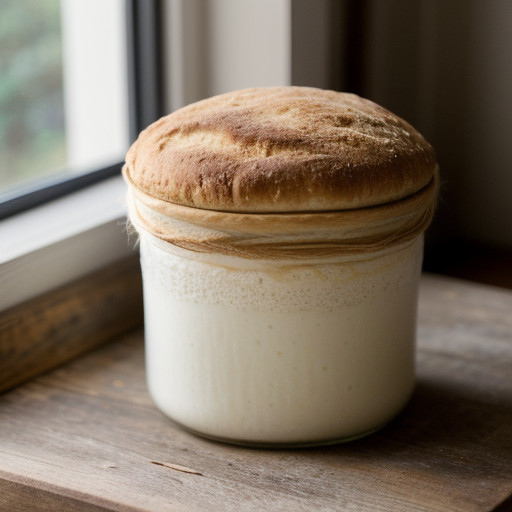
Sourdough Starter
Description
This recipe guides you through creating a vibrant sourdough starter from scratch, the foundational element of artisanal bread making. By combining unbleached flour, rye, and water, you cultivate wild yeast and bacteria that give sourdough its distinctive tang and airy crumb. The process requires patience, as the mixture ferments over several days, developing a sharp, pleasant aroma. Once active and bubbly, this starter becomes a kitchen staple, easily maintained with regular feedings. It is perfect for bakers looking to master the art of traditional bread, offering a rewarding connection to the slow fermentation process. Store it properly to keep your starter healthy for years of baking.Ingredients
Directions
-
In a clean glass jar, combine 1 cup of unbleached flour, 1/2 cup of whole-grain rye flour, and 1 cup of bottled still water.
-
Stir the mixture thoroughly with a spoon until no dry flour remains and the batter is smooth.
-
Cover the jar loosely with a kitchen towel or lid (do not seal tightly) and let it sit at room temperature for 2 to 3 days.
-
After 2 to 3 days, the mixture should begin to smell sour. Discard half of the starter if desired, or simply proceed to feed it.
-
Add 2/3 cup of unbleached flour and 1/2 cup of water to the existing mixture. Stir well to combine.
-
Cover the jar again and let it ferment at room temperature for another 24 hours.
-
Repeat the feeding process (adding 2/3 cup flour and 1/2 cup water) daily for 2 to 3 more days until the starter is bubbly, rises when fed, and has a sharp, pleasant aroma.
-
Once active, your starter is ready to use for baking. Refrigerate the remaining starter after use.
Nutrition Facts
Servings 1
- Amount Per Serving
- Calories 218.4kcal
- % Daily Value *
- Total Fat 0.6g1%
- Saturated Fat 0.1g1%
- Cholesterol 0.0mg0%
- Sodium 1.2mg1%
- Total Carbohydrate 45.6g16%
- Dietary Fiber 1.6g7%
- Sugars 0.2g
- Protein 6.0g12%
* Percent Daily Values are based on a 2,000 calorie diet. Your daily value may be higher or lower depending on your calorie needs.
Note
Use bottled still water to avoid chlorine, which can inhibit yeast activity.
Keep the starter at a consistent room temperature (70-75&# 194;°F or 21-24ðC) for best fermentation results.
If the starter develops a hooch (liquid on top), stir it back in before feeding.
To store long-term, refrigerate the fed starter. Let it come to room temperature and feed it once or twice before using it in a recipe to ensure maximum activity.
A healthy starter will double in size within 4-6 hours after feeding at room temperature.
sourdough, starter, fermentation, yeast, bread, rye, flour, homemade, leaven, culture, baking, wild yeast, fermented, bread making, artisan, vegetarian, vegan, healthy, traditional, flour water
