

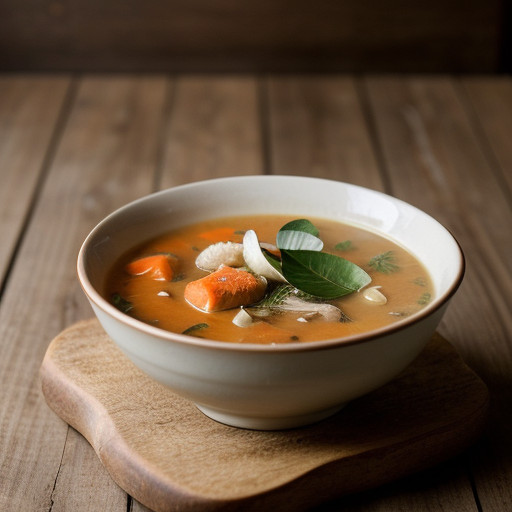
Ukha (Clear Salmon Soup)
Description
This traditional Russian Ukha is a masterpiece of clarity and flavor. Unlike chunky chowders, this soup relies on a double-straining technique using an egg white raft to achieve a broth that is literally see-through yet deeply savory. The base is built from smelt bones and aromatic vegetables like parsnip, carrot, and leek, creating a rich foundation without the heaviness. Fresh salmon fillets are gently poached in the final moments to ensure they remain silky and tender.Directions
-
In a large stock pot, combine 6 cups water, smelts, onion, quartered carrot, leek, celery, parsnip, bouquet garni, salt, and pepper.
-
Bring the mixture to a boil over high heat, periodically skimming off the foam as it rises to the top.
-
Cover the pot, reduce the heat, and simmer for 35 minutes.
-
Strain the stock through a fine sieve into a clean pot, pressing the solids with the back of a spoon to extract as much liquid as possible.
-
Discard the solids.
-
Return the stock to the heat and add the salmon trimmings, white wine, new potatoes, and thin carrots.
-
Bring to a boil, then reduce the heat to low and simmer, covered, until the vegetables are tender, about 25 minutes.
-
Strain the stock into a clean pot, discarding all the solids except the potatoes and carrots.
-
Rinse the potatoes and carrots carefully without mashing them, and set aside.
-
Return the stock to low heat and simmer for several minutes.
-
Add the egg white and crushed eggshell to the stock and increase the heat to medium-high.
-
Bring to a boil, beating constantly with a wire whisk.
-
When the stock boils, the egg white will start rising to the surface, forming a raft.
-
Turn off the heat and let the pot stand for five minutes to allow the raft to clarify the broth.
-
Line a colander with a double layer of dampened cheesecloth and strain the stock into a clean pot.
-
Add the salmon fillets to the hot stock and poach over medium-low heat until cooked through, about 5 minutes.
-
Taste and adjust the seasonings with salt and white pepper if needed.
-
Halve the reserved potatoes and cut into wedges.
-
Cut the reserved carrots into fine dice.
-
Divide the fish fillets among six soup bowls.
-
Add a few potato wedges and diced carrots to each bowl.
-
Ladle the clear stock into the bowls, sprinkle with scallions, and garnish with lemon slices.
Nutrition Facts
Servings 6 cups
- Amount Per Serving
- Calories 250kcal
- % Daily Value *
- Total Fat 8.5g14%
- Saturated Fat 1.5g8%
- Cholesterol 120mg40%
- Sodium 350mg15%
- Total Carbohydrate 12.0g4%
- Dietary Fiber 2.0g8%
- Sugars 3.0g
- Protein 28.0g57%
* Percent Daily Values are based on a 2,000 calorie diet. Your daily value may be higher or lower depending on your calorie needs.
