

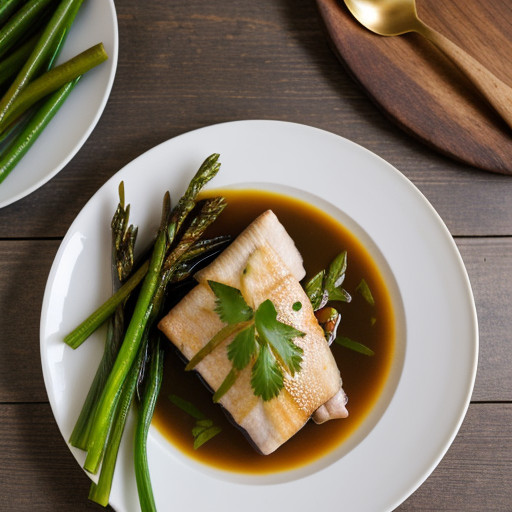
Savory Poached Carp (Hot or Jelled)
Description
This classic dish features fresh carp fillets gently poached in a fragrant broth infused with minced onions, celery, carrots, and lemon. The cooking liquid is reduced with sugar and vinegar to create a rich, glossy sauce that can be served immediately over the tender fish or chilled to set into a delicate savory jelly. The flavor profile is a harmonious balance of savory depth from the vegetable stock and bright acidity from the wine vinegar and lemon. It is an elegant yet comforting centerpiece suitable for family dinners or special occasions.Directions
-
Tie the parsley sprigs together with kitchen twine to create a bouquet garni bundle.
-
Cut the fresh carp into 1-inch thick slices.
-
Place the minced red onions, wine vinegar, and 1/4 cup of water into a 3-quart Dutch oven.
-
Bring the mixture to a boil over medium heat.
-
Cook, uncovered, stirring often, until all the liquid has completely evaporated.
-
Add the remaining 1/2 cup water, vegetable stock, minced celery, minced carrot, lemon slices, 2 tablespoons of sugar, and the parsley bundle to the pot.
-
Bring the broth back to a boil.
-
Reduce the heat to maintain a slow boil and cook, uncovered, for 5 minutes to infuse the flavors.
-
Gently add the carp slices to the pot.
-
Bring the liquid to a boil again and baste the fish with the broth several times.
-
Reduce the heat to a simmer, cover the pot, and cook for 30 minutes.
-
Uncover the pot, raise the heat slightly, and continue to slow-boil for an additional 10 minutes.
-
Using a slotted spatula, carefully transfer the fish slices to a serving plate.
-
Discard the fish skin and carefully pull out any bones, separating the flesh to make them visible.
-
Spoon a little of the hot poaching liquid over the fish and cover the plate to keep warm.
-
Strain the contents of the pot through a fine sieve to remove solids.
-
Rinse out the Dutch oven and return the strained broth to the pot.
-
Stir in the remaining 2 teaspoons of sugar.
-
Bring the broth to a boil over high heat and reduce it until only about 1/4 cup of liquid remains.
-
Pour any liquid exuded from the fish on the plate back into the pot.
-
To serve hot, portion the fish onto warm plates and spoon the reduced poaching liquid over each serving.
-
To serve jelled, arrange the fish slices in a single layer in a wide casserole dish.
-
Pour the reduced poaching liquid evenly over the fish.
-
Cover the dish tightly and refrigerate overnight until the liquid sets into a jelly.
-
Cut the jelled fish into serving pieces and garnish with watercress sprigs.
Nutrition Facts
Servings 4 cups
- Amount Per Serving
- Calories 180kcal
- % Daily Value *
- Cholesterol 60mg20%
- Sodium 150mg7%
- Protein 25g50%
* Percent Daily Values are based on a 2,000 calorie diet. Your daily value may be higher or lower depending on your calorie needs.
carp, poached, fish, broth, jelly, savory, onions, celery, carrot, lemon, vinegar, vegetable stock, parsley, simmering, chilled, garnish, watercress, traditional, comfort food, appetizer
